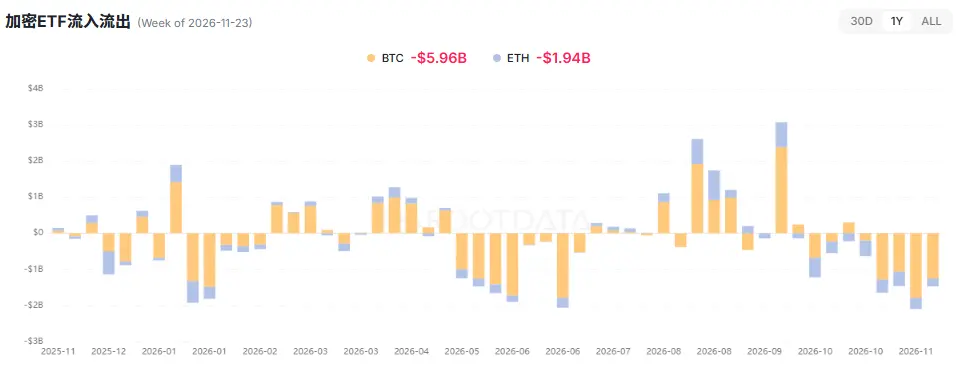
US spot Bitcoin ETFs recorded $5.7 billion in net outflows from November 1 through November 25, already surpassing June’s full-month record of $4.51 billion. The figures, from RootData and reported on November 27, 2026 at 15:17:31 UTC+8, put year-to-date net outflows at about $5.96 billion. Bitcoin fell below $60,000 again in November, reaching its lowest price since September 2024.
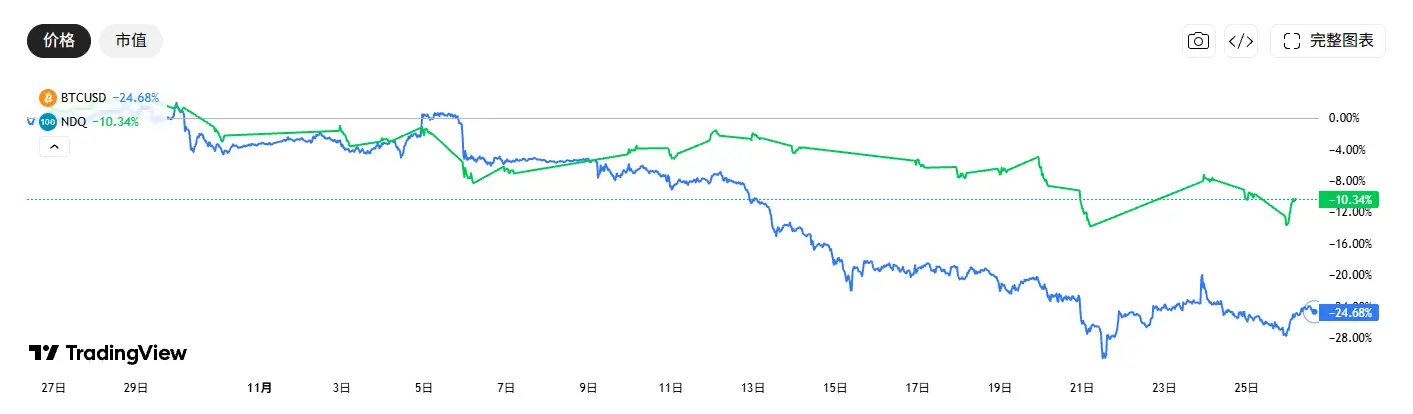
Bitcoin fell with equities but missed the rebound
In September, the Federal Reserve raised rates for the first time in three years. It was the first rate-hiking cycle for US spot Bitcoin ETFs since their launch nearly three years earlier. The Fed held its target range at 3.75%–4% on October 28 without signaling a change of direction. Bitcoin ETFs posted net outflows on 14 of the next 17 trading days, according to 10x Research.
Bitcoin and equities initially moved together. On November 5, as AI stocks sold off, the Nasdaq 100 fell 6.36% and Bitcoin lost about 5.5%. Inflation came in above expectations on November 10. After the Fed released its meeting minutes on November 18, CME FedWatch put the probability of a December rate increase near 95%.
Over the period beginning October 28, however, Bitcoin fell about 25%, against roughly 10% for the Nasdaq 100. Glassnode noted that US equities recovered above their November 3 election-day close, while Bitcoin fell again after the inflation release.
Crypto investors also faced risks that equity investors did not share. On the first trading day after the reported theft of about $6.3 billion from Binance, spot Bitcoin ETFs saw roughly $640 million in net outflows, the largest daily withdrawal since late June. ViaBTC chief analyst Jeff Ko attributed the outflow primarily to sentiment: regulated institutions custody the ETFs’ Bitcoin, and the funds had no direct link to Binance. OneKey’s Yishi raised a separate concern about custody concentration, noting that Coinbase held most of BlackRock IBIT’s roughly 760,000 BTC and that its $320 million in insurance covered less than 1% of the value of IBIT’s holdings.
The November 3 midterm elections gave Democrats control of both houses of Congress. CertiK’s Stefan Muehlbauer judged that the proposed CLARITY Act would be difficult to pass in either the current or the next Congress. On November 11, MSCI announced that it would remove Bitcoin treasury company Strategy from its indexes.
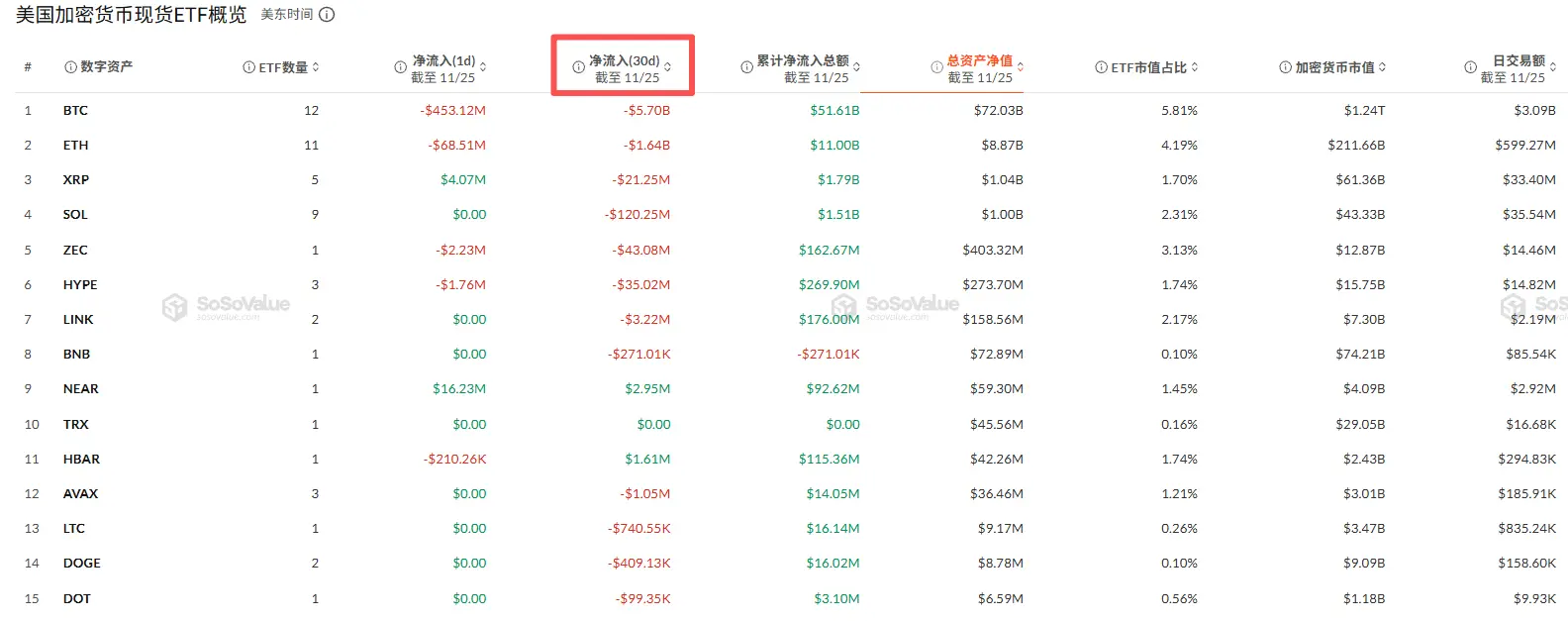
Unlike November 2025, when newly listed SOL and XRP ETFs attracted capital as Bitcoin and Ether funds lost it, the withdrawals in 2026 extended across most of the market. SOL ETFs turned negative in October after 14 consecutive weeks of net inflows. SoSoValue recorded net outflows in 12 of the 15 US spot crypto ETF categories over 30 days, including $1.64 billion from Ether ETFs.
Futures positions shrank, but ETF withdrawals continued
One possible source of ETF selling was the unwinding of basis trades, in which a fund holds spot exposure and shorts futures. By November 17, leveraged funds’ net short position in CME Bitcoin futures had fallen to about 1,211 contracts, equivalent to roughly 6,000 BTC. That was more than 90% below the December 2024 peak, according to CFTC positioning data.
The figures suggested that much of the basis trade had already unwound by early November. Yet substantial ETF outflows continued. In 10x Research’s view, the pattern was more consistent with investors steadily reducing their Bitcoin allocations. The filings could not identify the sellers: investment advisers and wealth platforms accounted for about 40.5% of reported holdings in third-quarter 13F filings, but those disclosures covered only 27.6% of the Bitcoin in the funds. Filings due in February 2027 would offer only a partial picture of fourth-quarter changes.
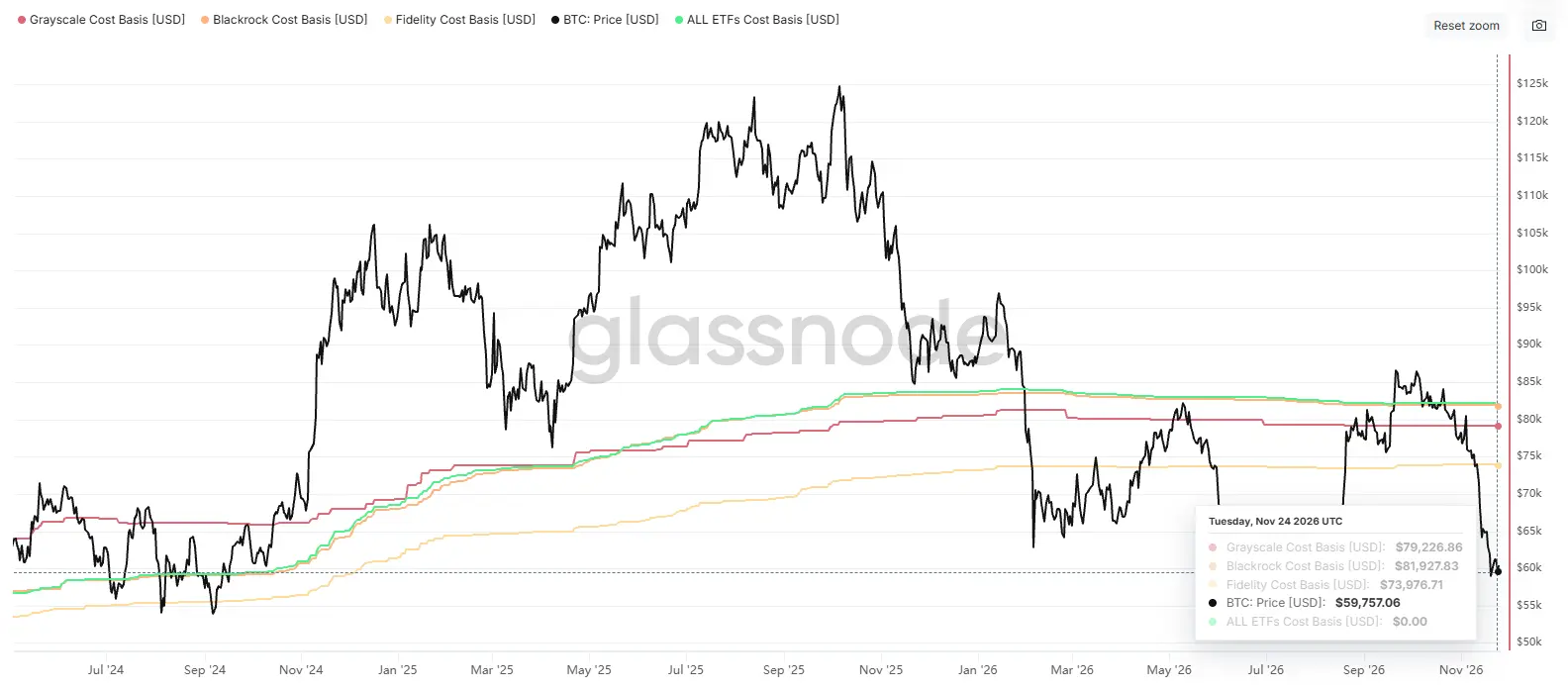
Glassnode’s cost estimates showed what selling would have meant for the average holder. On November 24, Bitcoin traded near $59,757, against estimated average acquisition prices of $81,928 for BlackRock’s IBIT holders, $79,227 for Grayscale holders and $73,977 for Fidelity holders. For IBIT holders, the gap represented an average unrealized loss of about 27%.
Treasury companies and miners offered less buying support
According to RootData, Strategy held 851,305 BTC at an average cost of about $75,000, leaving it with an unrealized loss of roughly 20%. Its market valuation stood at 0.83 times net asset value, and it had added only 2,788 BTC in 30 days. In late May, it sold 32 BTC to pay preferred-stock dividends, its first Bitcoin sale since December 2022.
MSCI’s removal of Strategy, Metaplanet and Upexi was scheduled to take effect after the November 30 close. JPMorgan estimated that the change could trigger about $2.8 billion in passive selling. Strategy expected a limited impact, saying the affected funds held about 3.1% of its shares. The estimate concerned sales of shares, not confirmed sales of Bitcoin.
Miner MARA said in its third-quarter shareholder letter that it had sold 13,597 BTC after the quarter ended, raising about $1.1 billion. It said it would continue selling to fund projects including AI infrastructure. Separately, RootData measured a 15,162 BTC decline in MARA’s holdings over 30 days.
Stablecoin supply was contracting as well. Figures from rwa.xyz put total stablecoin market capitalization at $273.09 billion, down 5.58%, or about $16 billion, in 30 days. Coinkarma founder Benson Sun said that while he considered long-term indicators favorable, both stablecoin and ETF flows remained negative over that window. He said he would wait for ETF net inflows to turn positive before buying.
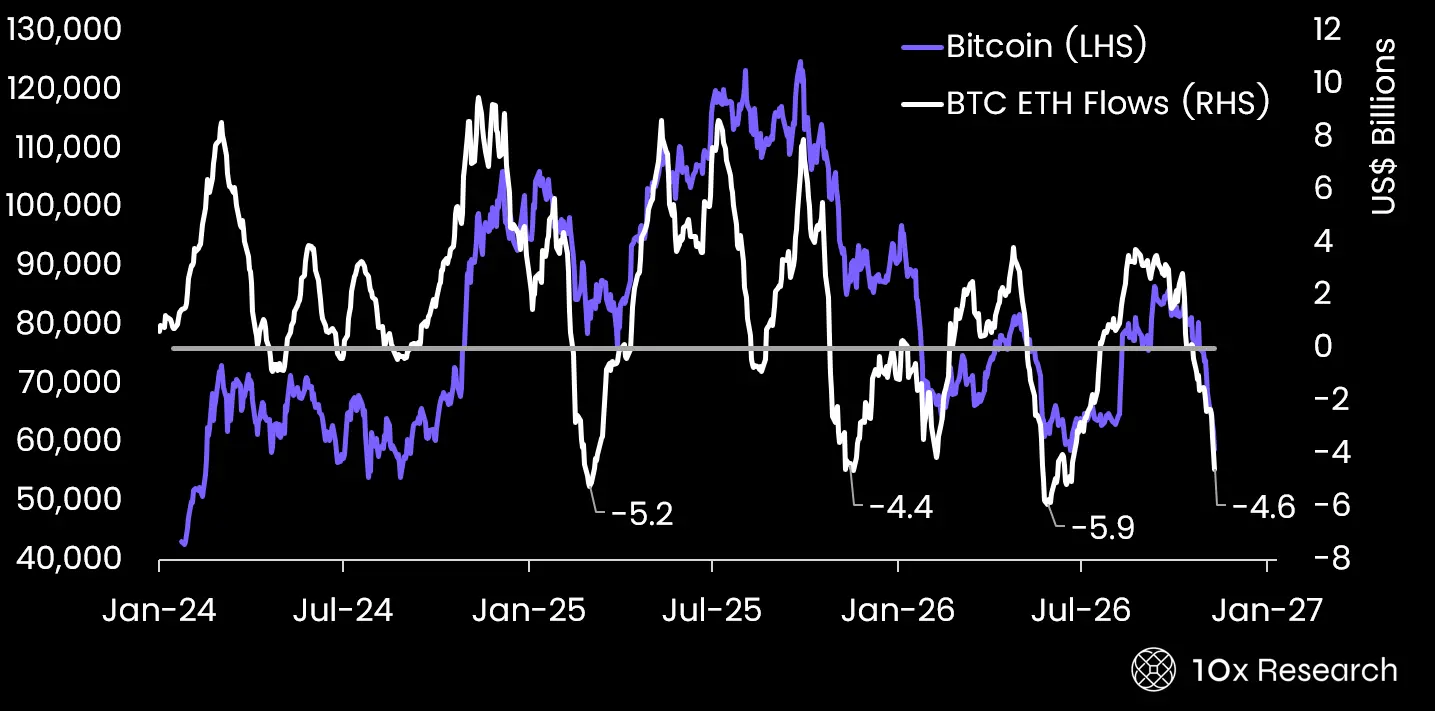
Three earlier outflow episodes do not establish a bottom
The rolling 30-day net outflow measured by 10x Research was about $4.6 billion, distinct from RootData’s $5.7 billion calendar-month figure through November 25. It was the fourth time since early 2025 that Bitcoin ETFs had lost between $4 billion and $6 billion over 30 days. Each of the three earlier episodes coincided with a Bitcoin decline of about $20,000, and the deepest outflows roughly aligned with local price lows. Three observations were too few to establish that the pattern would repeat.
Beyond the November 30 index changes, two questions remained open: what the Fed would signal about its 2027 rate path at the December meeting, and whether ETF holders would realize losses before December 31. During Christmas week in 2025, Bitcoin ETFs recorded about $1.1 billion in net outflows across six consecutive days. For 2026, 10x Research estimated that roughly $14 billion in ETF positions were below their holders’ acquisition cost. That was the value of underwater positions, not a forecast of redemptions.
ETF shares were subject to wash-sale rules, while directly held Bitcoin was not. A tax-motivated ETF sale therefore would not necessarily mean the investor had left Bitcoin. A January return of funds was possible if December brought tax-loss selling, but neither the selling nor a subsequent reversal was assured.