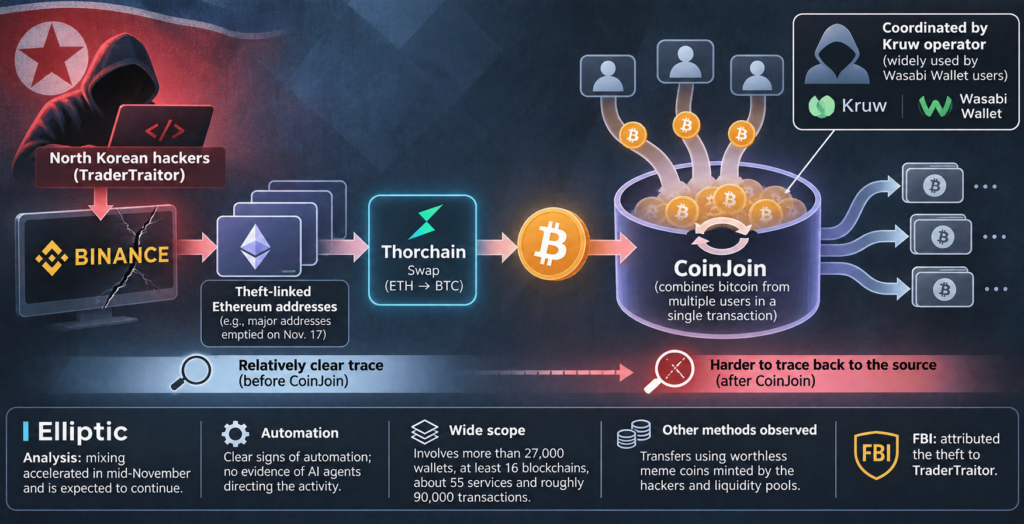
As reported on November 24, 2026, blockchain analytics firm Elliptic said North Korean hackers had moved at least $247 million from a reported $6.4 billion Binance theft into Bitcoin CoinJoin transactions. The figure covered only funds that had entered mixing about a month after the October 29 theft—not the full amount taken.
CoinJoin combines bitcoin from multiple users in a single transaction, making it harder to trace funds back to their source. Elliptic co-founder Tom Robinson told Decrypt that nearly all the mixing was coordinated by one person: the operator of Kruw, a CoinJoin coordinator widely used by Wasabi Wallet users. Robinson said the operator had declined to block the funds, and Elliptic expected the laundering activity to continue.
Elliptic said mixing accelerated in mid-November. On November 17, the attackers emptied five of the nine largest Ethereum addresses associated with the theft, moving about 488,000 ETH. The funds were then swapped into bitcoin through Thorchain and often entered CoinJoin within hours. The sequence resembled the pattern attributed to North Korea after the $1.5 billion Bybit theft in early 2025; the two thefts involved different amounts.
The broader operation involved more than 27,000 wallets across at least 16 blockchains, roughly 55 services and about 90,000 transactions. Elliptic described clear signs of automation but said it found no evidence that AI agents directed the activity. It pointed instead to conventional software operating at set times and in set amounts. The firm had also previously identified transfers using worthless meme coins minted by the hackers and liquidity pools.
The FBI has attributed the theft to the North Korean group TraderTraitor. Binance said it would cover all customer losses. At the time of the report, about $2.85 billion had been frozen, while roughly $2.35 billion remained in theft-linked addresses, including 18,270 bitcoin taken directly from Binance. The amount actually cashed out remained limited.