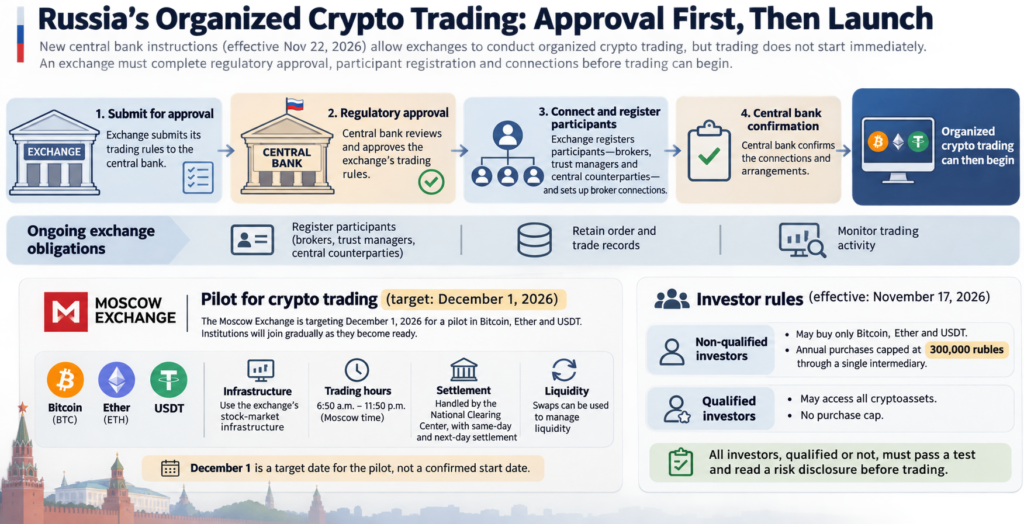
As reported on November 23, 2026, Russian central bank instructions allowing exchanges to conduct organized cryptocurrency trading had taken effect the previous day. That did not mean trading could begin immediately: an exchange first needed the regulator’s approval of its trading rules, broker connections and central bank confirmation.
Exchanges must also register participants, including brokers, trust managers and central counterparties; retain order and trade records; and monitor trading activity.
The Moscow Exchange was targeting December 1, 2026 for a pilot covering Bitcoin, Ether and USDT. In a November 2 statement, it said institutions would join the pilot gradually as they became ready. The exchange planned to use its stock-market infrastructure, operate from 6:50 a.m. to 11:50 p.m. Moscow time, and have the National Clearing Center handle same-day and next-day settlement. Swaps could be used to manage liquidity. December 1 remained a target, not a confirmed start date.
Separate investor rules took effect on November 17. Non-qualified investors may buy only Bitcoin, Ether and USDT, with annual purchases capped at 300,000 rubles through a single intermediary. All investors, qualified or not, must pass a test and read a risk disclosure before trading. Qualified investors may access all cryptoassets without that purchase cap.