
Bitcoin fell toward $63,000 on Wednesday, November 18, 2026, extending a six-week retreat. At the time of the original report, it was approaching $62,000, down 3.8% for the session. The move came as Anthropic prepared to price its IPO that Wednesday, ahead of a planned Nasdaq debut on Thursday under the ticker ANT.
The timing raised a question: were investors selling Bitcoin to buy Anthropic shares? Kraken chief economist Thomas Perfumo told MarketWatch the IPO could be drawing capital from risk assets. Binance founder Changpeng Zhao also named the listing as one possible factor. Neither claim establishes that the IPO caused Bitcoin’s decline.
The earlier IPO comparison has limits
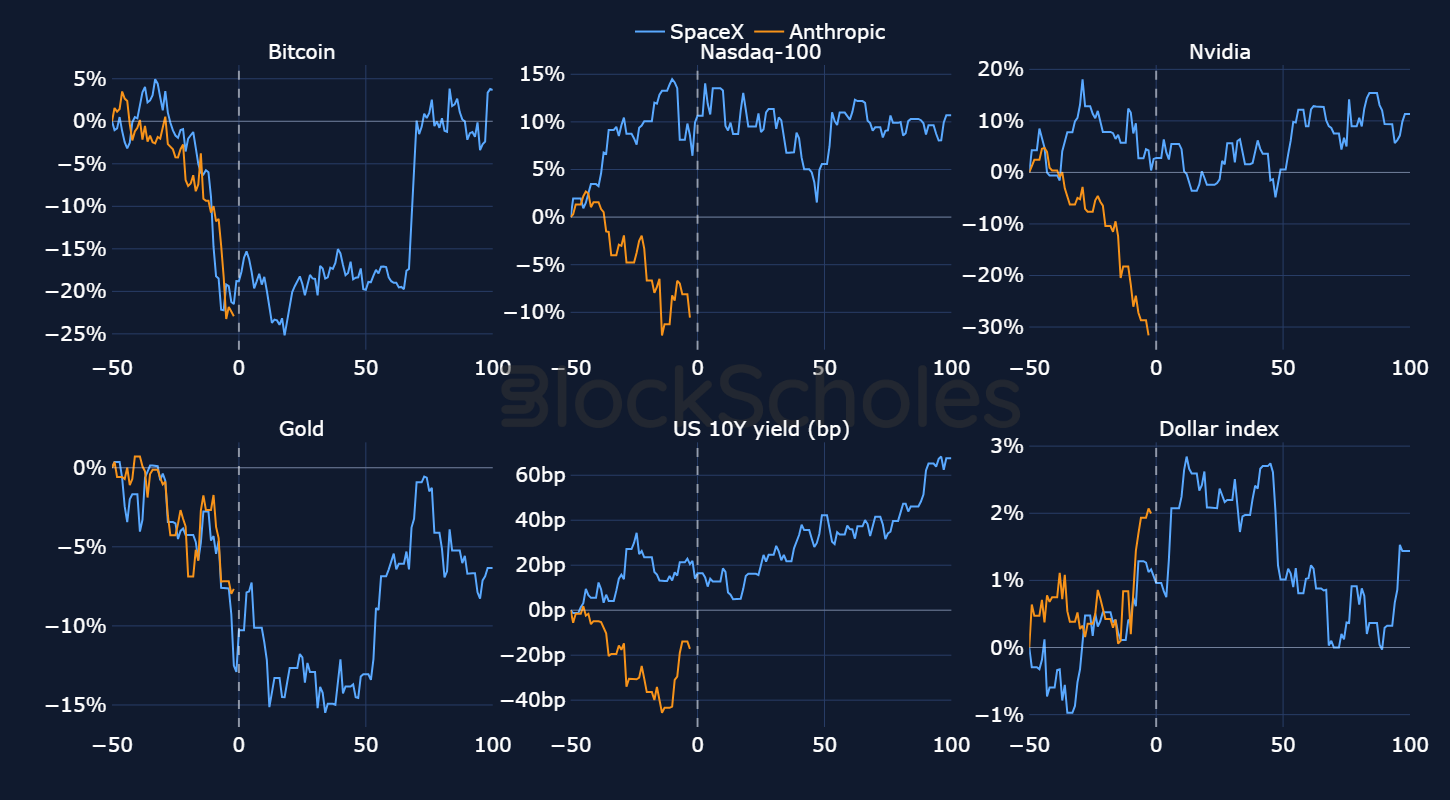
Bitcoin fell 23% in the 50 days before Anthropic’s planned listing, compared with a 19% fall over the equivalent period before SpaceX listed in June. But the surrounding markets differed. Block Scholes analyst Thahbib Rahman noted that AI stocks had rallied ahead of SpaceX’s IPO, whereas this time they were falling alongside crypto. Over the preceding 50 days, Nvidia was down 32% and the Nasdaq 11%.
Bitcoin’s 30-day correlation with Nvidia rose from 0.20 to 0.56, while its correlation with gold fell from 0.63 to 0.39. Rahman described liquidity as moving out of crypto and equities together. Those figures complicate the idea of a simple shift from Bitcoin into AI shares; they do not identify a single cause for the selloff.
Selling pressure beyond the IPO theory
U.S. spot Bitcoin ETFs recorded $239.9 million in outflows on Tuesday, November 17, including $209.5 million from BlackRock’s IBIT. Nearly $2 billion in leveraged crypto positions were liquidated during the preceding weekend’s rout, adding to the pressure as exchanges closed positions. Hilbert Group portfolio manager Jesse Marre called the selloff “simply a stop loss run,” arguing that derivatives traders had already capitulated. Rising Treasury yields, a stronger dollar and renewed expectations of Federal Reserve rate hikes were also cited as pressures on speculative assets.
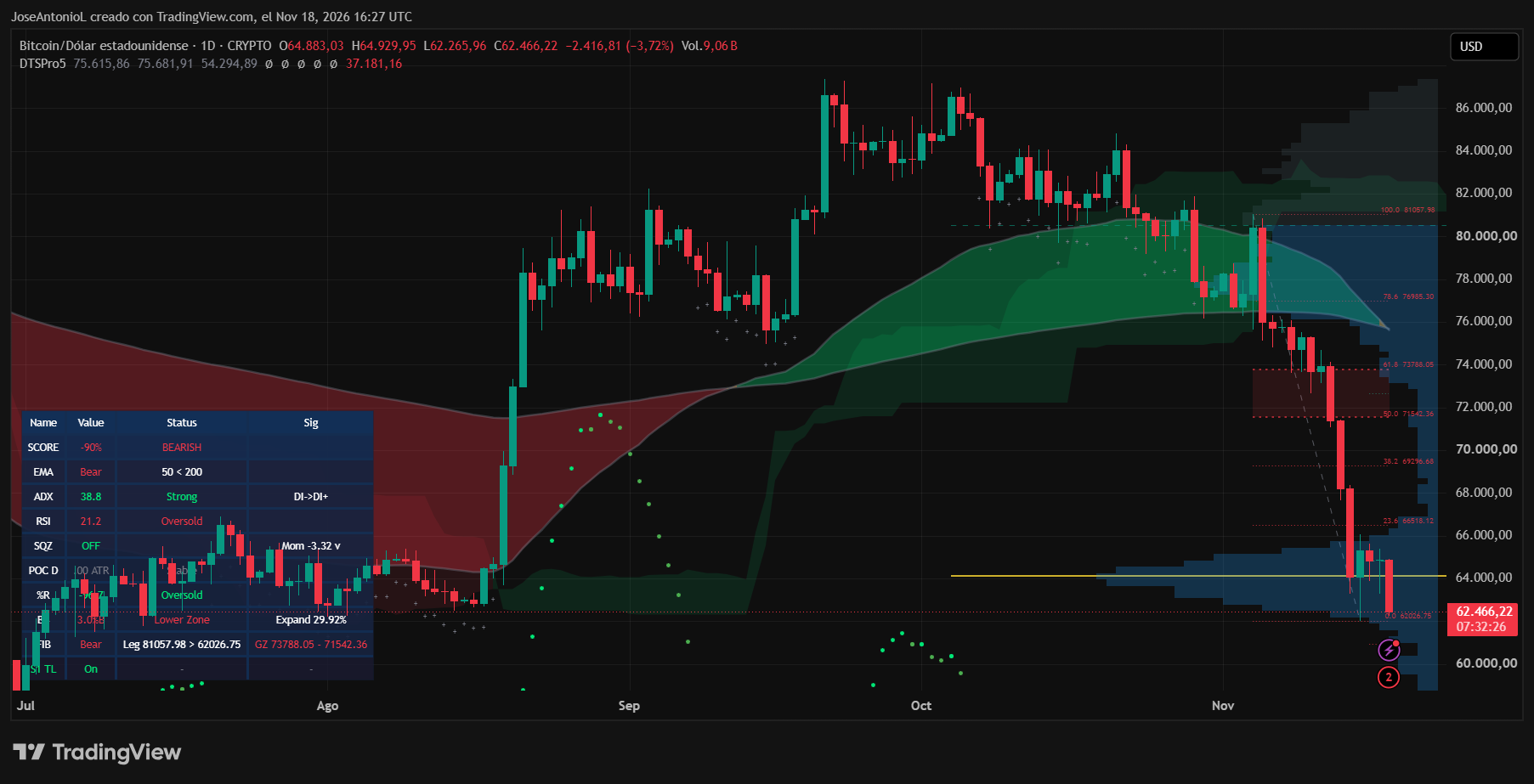
The chart offered little reassurance on its own. Bitcoin’s relative strength index stood at 21.8, below the commonly used oversold threshold of 30, while an average directional index of 38.7 indicated a strong downward trend. Its 50-day exponential moving average was below its 200-day counterpart. These are measures of momentum, not guarantees of what happens next; an oversold reading does not mean selling has ended.
Around $62,000—near Sunday’s low—was the immediate level in focus. Glassnode data showed buyers had absorbed 66,000 BTC between $62,000 and $66,000 during heavy selling, while stablecoin supply had contracted 4.2% over 90 days. The report identified $60,000 as the next psychological level below $62,000, with resistance near $65,500, $69,300 and $73,700.
BitMEX co-founder Arthur Hayes framed Anthropic’s debut as a barometer rather than necessarily a drain on Bitcoin: he said Bitcoin could rise if the shares soared, while a weak debut could add pressure across risk assets. As of the November 18 report, Anthropic’s pricing and trading debut were still scheduled, not completed.