As of Nov. 18, 2026, Russia’s central bank listed 30 authorized crypto exchange operators. That did not establish whether retail customers could trade through any of them, even though rules allowing retail investors to buy Bitcoin, Ether and Tether’s USDt had taken effect on Nov. 16.
The registry includes Sberbank and VTB. Alexander Nam of HSE University’s Center for Decentralized Finance and Digital Financial Assets Research said investor testing, order execution, settlement and custody remained hurdles. “Being included in the registry does not in itself mean readiness to fully serve investors,” he told Cointelegraph. Alexander Brazhnikov of the Russian Association of Cryptocurrency and Blockchain said he could not identify a registered operator offering confirmed retail access as of Nov. 16.
Sanctions concerns could also affect participation. A person familiar with regulatory discussions told Cointelegraph that some companies were reluctant to join the public registry for fear of becoming sanctions targets. According to that source, industry representatives asked the Bank of Russia to keep the list private, but the regulator refused, saying crypto businesses should face the same requirements as traditional financial service providers.
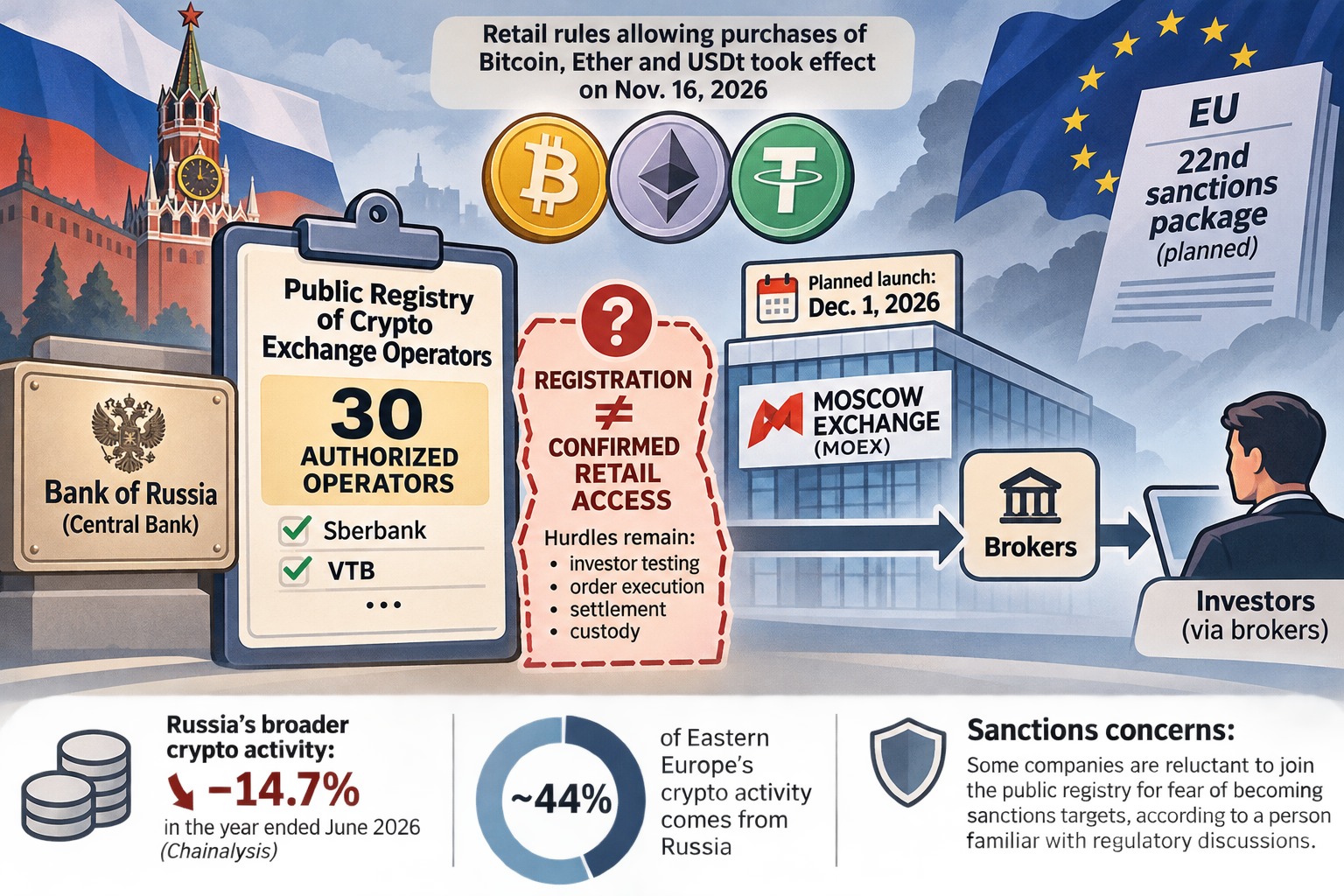
Moscow Exchange planned to begin crypto trading on Dec. 1, with investors accessing it through brokers. Cointelegraph had not received responses from Moscow Exchange, VTB or T-Invest Lab about their launch plans by publication time. Meanwhile, the European Commission reportedly planned to present a 22nd sanctions package ahead of the Nov. 26–27 European Council summit; it was expected to include new restrictions on crypto platforms. Those plans were not enacted measures in the Nov. 18 report.
The planned trading launch comes against a decline in Russia’s broader crypto activity: transaction value fell 14.7% to $284.1 billion in the year ended June 2026, according to Chainalysis. Russia nevertheless accounted for roughly 44% of Eastern Europe’s crypto activity.