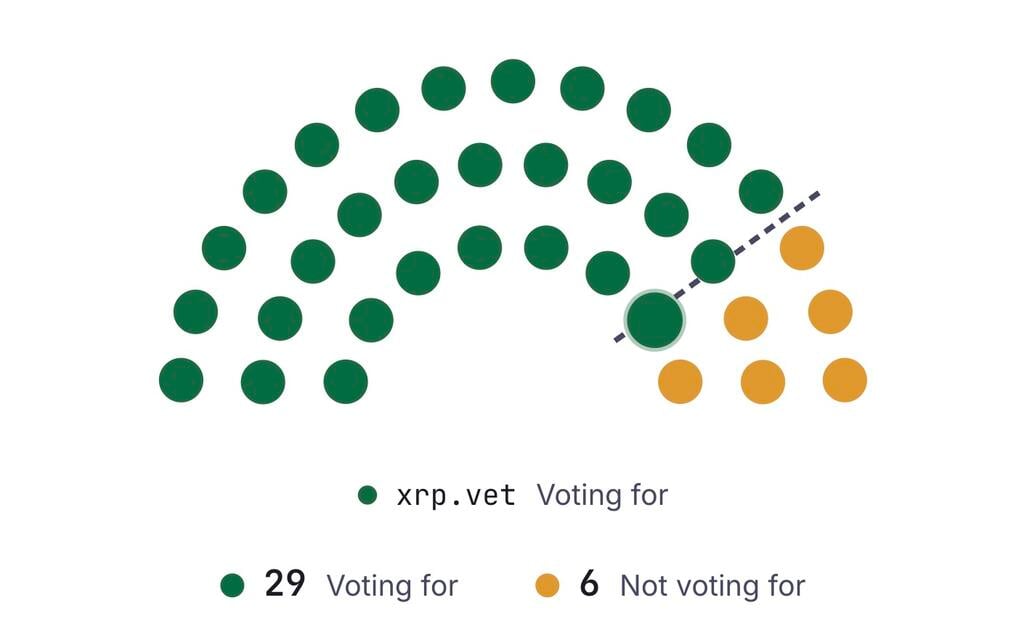
The XRP Ledger’s two lending amendments each secured 29 of 35 validator votes on Nov. 27, 2026, starting a 14-day activation countdown, according to XRPScan. If support holds, native lending and borrowing could go live as early as Dec. 11 for the first time since the ledger launched in 2012.
Hussein Zangana, director of community at the XRP Ledger Foundation, announced on X that he had cast the 29th yes vote with his validator. That took LendingProtocolV1_1 above the 80% threshold, where support must remain through activation. The companion LendingProtocol amendment also had 29 votes. A third amendment, SingleAssetVault, had 30 votes and could activate earlier, on Dec. 9.
How the loans would work
Ripple engineer Vito Tumas first proposed the protocol in April 2024. Under the XLS-65 standard, each vault would hold a single asset, such as XRP or RLUSD. Depositors would receive Multi-Purpose Tokens representing their shares in that vault.
Under XLS-66, a loan broker would assess borrowers off-chain and use vault funds to make fixed-rate, fixed-term loans. Interest payments would flow back to the vault. The protocol has no on-chain liquidations; a broker could put up its own capital to absorb the first losses if borrowers default.
Jazzi Cooper, head of product at RippleX, said the team deliberately paired lending at the protocol level with built-in compliance and off-chain underwriting. J. Ayo Akinyele, head of engineering at RippleX, said the vaults and lending protocol underwent multiple independent audits, a public Attackathon, AI-assisted reviews, community testing and validator review. Ripple and Common Prefix also performed formal verification using the Lean 4 theorem prover.
Clearpool tested a loan cycle; Evernorth is assessing treasury use
Clearpool said it plans an XRPL credit fund with Ripple and Cicada Partners and has already tested a full loan cycle on Devnet. The test was not a live business loan. “We want to make real loans to real businesses,” said Tom Lombardi of Cicada Partners.
Evernorth CEO Ashish Birla described a more exploratory effort: his company is assessing whether XLS-66 could help its treasury generate yield. Both prospective uses remain distinct from the validator vote, which started the activation window but did not itself enable lending.