As reported on November 10, 2026, a higher-than-forecast US inflation reading sharpened attention on the Federal Reserve’s December rate decision. Crypto markets were lower following the report, though the figures alone do not establish what caused the decline.
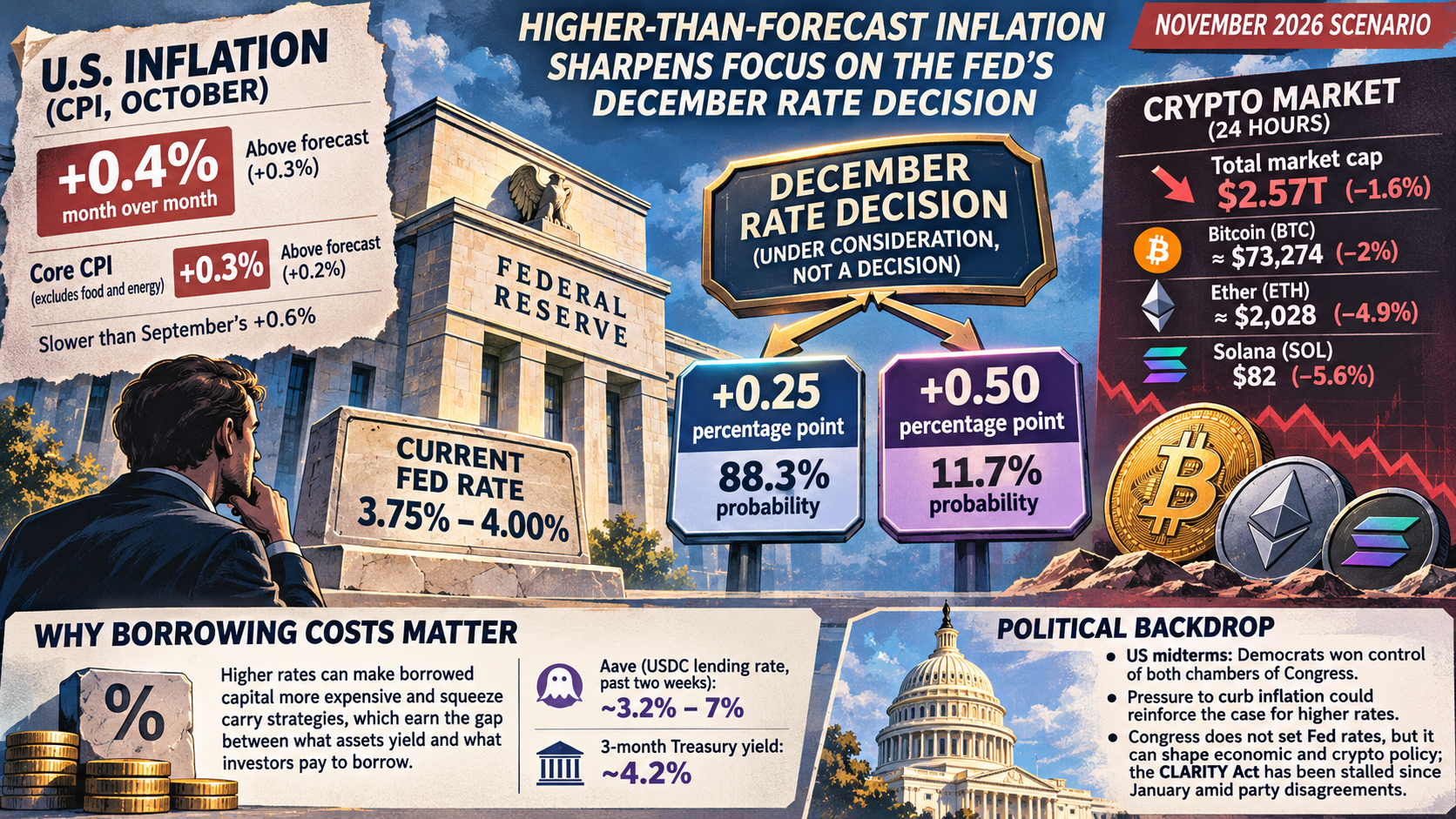
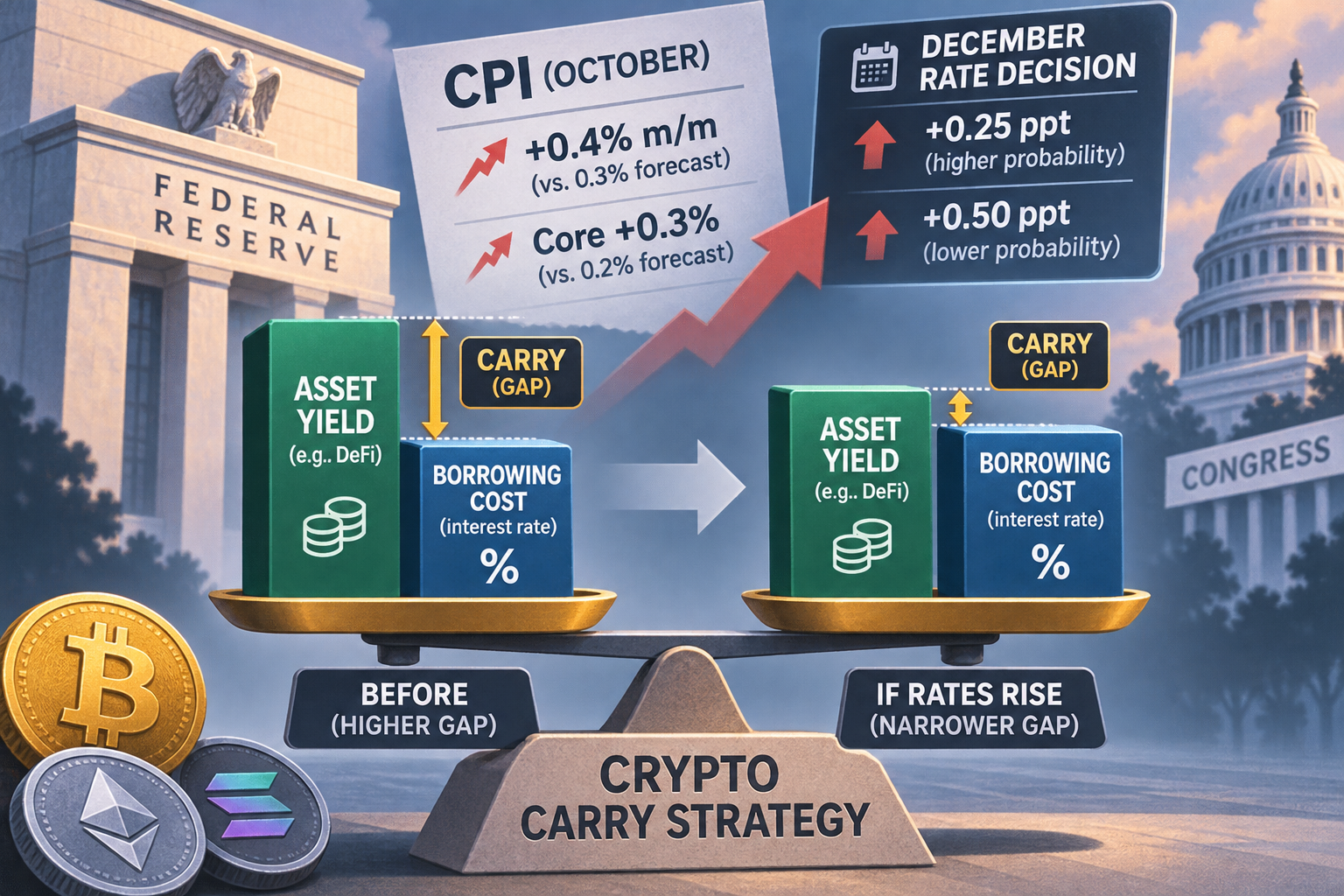
The Consumer Price Index rose 0.4% in October from September, above economists’ 0.3% forecast but slower than September’s 0.6% increase, according to the Bureau of Labor Statistics. Core inflation, which excludes food and energy, rose 0.3% against an expected 0.2%.
A larger hike remained a possibility, not a decision
The Fed’s benchmark rate stood at 3.75%–4.00% after a quarter-point increase in September and no change in October. Hours before the CPI report, Fed Governor Christopher Waller said in London that another core inflation reading of 0.3% or higher could warrant considering a half-point hike in December. His remarks described a condition for consideration, not an announced rate change.
After the CPI release, Jeff Anderson, head of US at crypto trading firm STS Digital, said markets were pricing approximately 27 basis points of tightening into the December rate curve. CME FedWatch data at 16:28 UTC on November 10 put the probability of a quarter-point hike at 88.3% and a half-point hike at 11.7%.
Why borrowing costs matter
CoinGecko figures cited in the November 10 report showed total crypto market capitalization down 1.6% over 24 hours to $2.57 trillion. Bitcoin traded near $73,274, down 2%; Ether was around $2,028, down nearly 5%; and Solana was $82, down 5.6%.
Higher rates could make borrowed capital more expensive for crypto investors. Adam Haeems, head of asset management at Tesseract Group, said that would squeeze carry strategies when borrowing costs rise relative to the yield on their assets. He noted that, over the preceding two weeks, rates paid to USDC lenders on Aave’s main market ranged from about 3.2% to 7%, while three-month Treasury yields stayed close to 4.2%. Those figures illustrate a potential shift in relative returns, not a forecast of investor flows.
The report also followed the US midterm elections by a week. Democrats had won control of both chambers of Congress, and Anderson said political pressure to curb inflation could reinforce the case for higher rates. He remained skeptical that further hikes would address inflation’s underlying causes. Congress does not set Fed rates, but it can shape economic and crypto policy; the CLARITY Act had been stalled since January amid disagreements between the parties.