
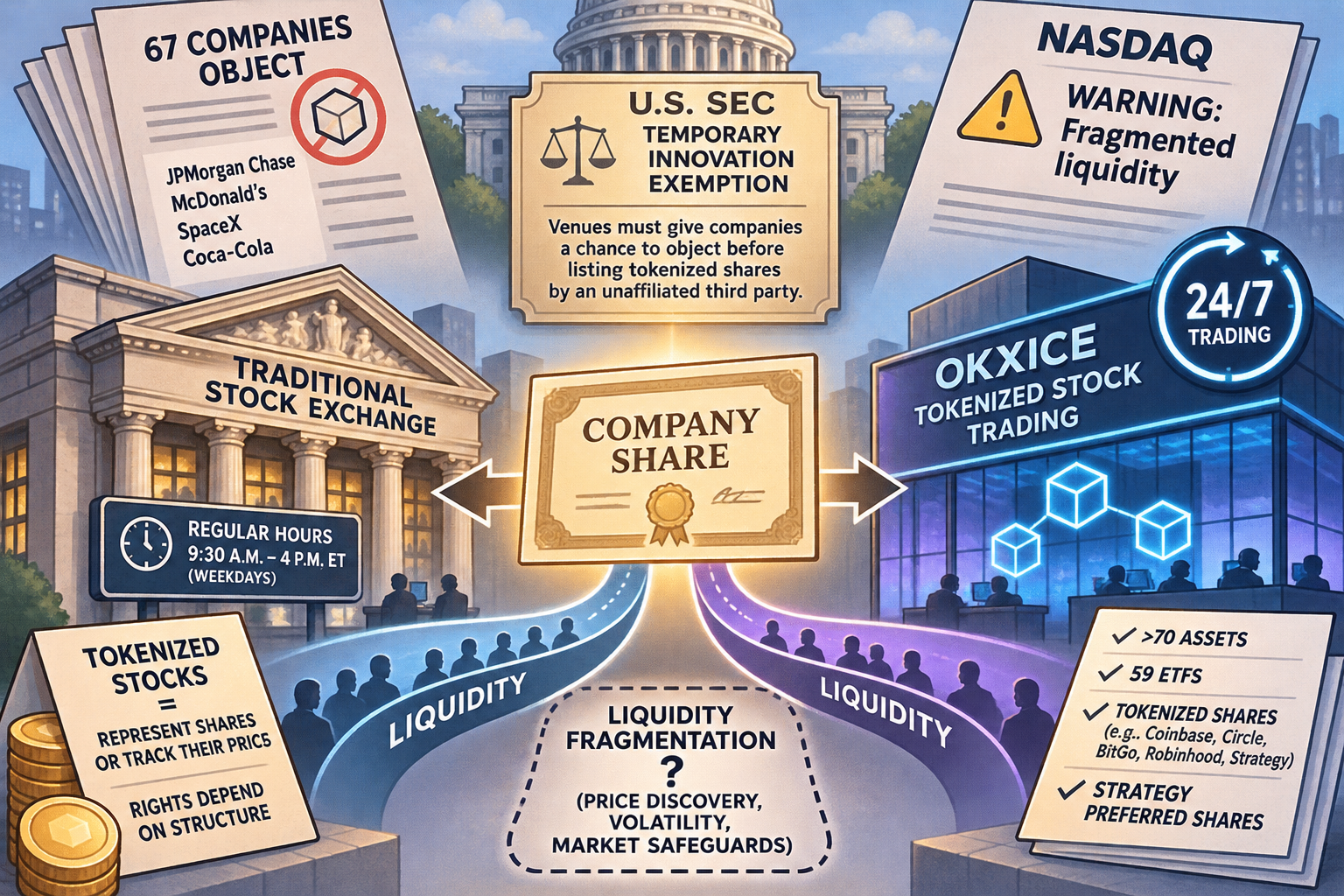
As reported on November 12, 2026, crypto exchange OKX and Intercontinental Exchange, the parent of the New York Stock Exchange, were planning to launch tokenized-stock trading through OKXICE on November 23. The planned rollout faced objections from 67 companies and a warning from Nasdaq about fragmented liquidity.
OKXICE is expected to offer eligible US customers round-the-clock trading under the US Securities and Exchange Commission’s temporary Innovation Exemption. The exemption requires venues to give companies a chance to object before an unaffiliated third party lists tokenized versions of their shares. JPMorgan Chase, McDonald’s, SpaceX and Coca-Cola were among those that objected.
OKX expects the venue to list more than 70 assets, including 59 exchange-traded funds and tokenized shares of Coinbase, Circle, BitGo, Robinhood and Strategy. Strategy’s preferred shares are also in the planned lineup. Tokenized stocks can represent shares or track their price; the rights they confer depend on their structure. OKXICE co-chair Andrew Cuomo told Cointelegraph that investors would have “the same rights, protections and ownership that come with the underlying shares.”
The liquidity question
The distributed value of tokenized stocks and ETFs reached $3.88 billion on November 11, up 13.4% over 30 days. Growth in the market does not resolve the question of how trading the same stocks across separate venues might affect prices.
In an October study, the International Monetary Fund found tokenized stocks were about 1.5 times as volatile as their counterparts in traditional markets. Liquidity was weakest on decentralized exchanges, where prices diverged further from traditional-market prices than they did on centralized exchanges. The IMF also warned that blockchain-based trading and settlement could remove safeguards that help markets absorb shocks, while leverage and closer market links could amplify fire sales and liquidity runs.
In a January filing, Nasdaq argued that tokenized-stock trading outside traditional market infrastructure could fragment liquidity and make the best available price harder to obtain. Cuomo, by contrast, argued that equities should be able to trade around the clock without investors giving up shareholder rights. Those are competing positions on the planned market structure, not evidence that its effects have been settled.