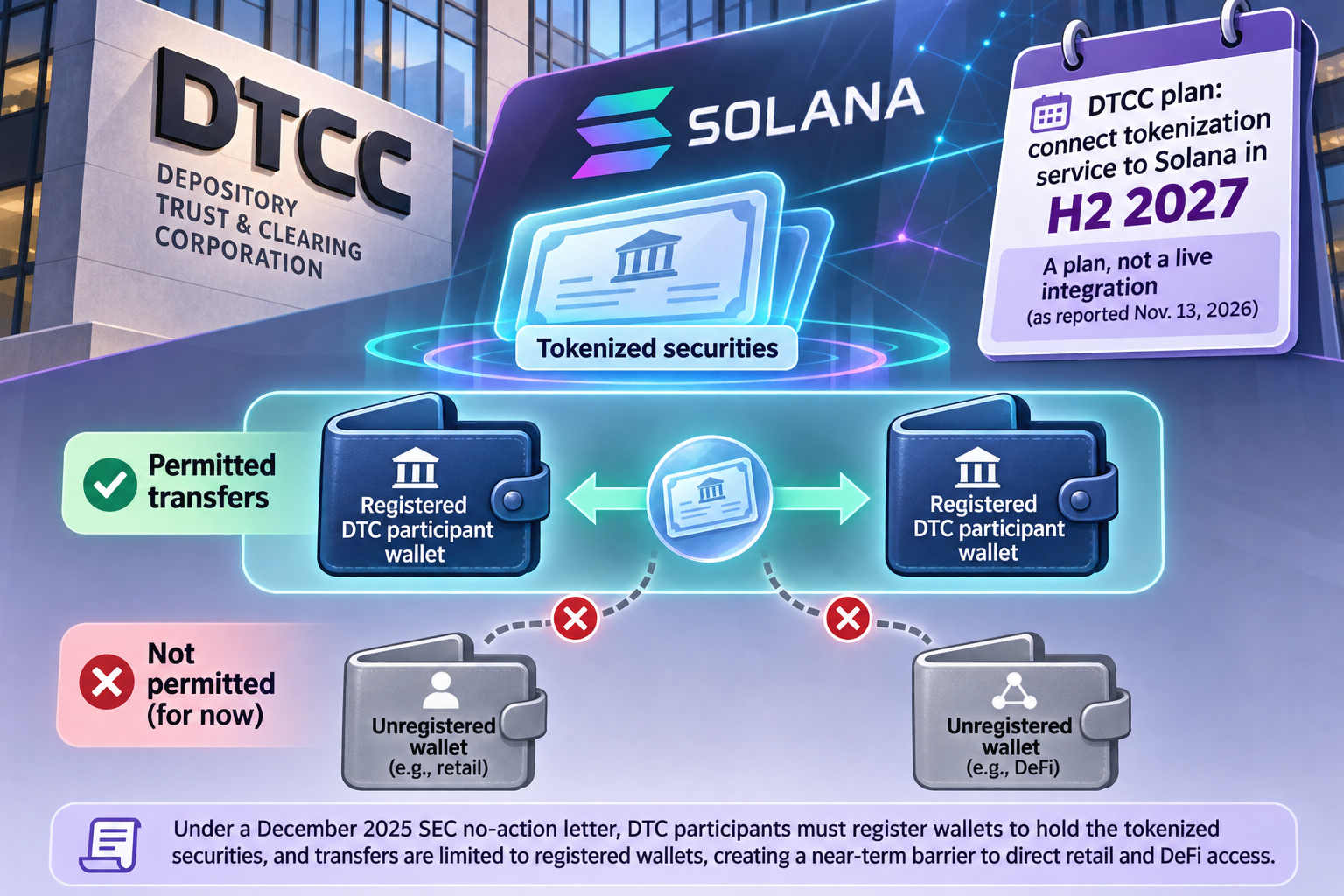
DTCC plans to connect its tokenization service to Solana in the second half of 2027, potentially allowing certain securities held by its Depository Trust Company (DTC) subsidiary to become digital tokens on the network. As reported on Nov. 13, 2026, the expansion was a plan, not a live integration. Analysts said its effect would depend on who can access the tokens—and whether institutions use them actively.
Access comes before activity
DTCC launched the service on Canton Network and its private Besu network on Oct. 28, 2026. It said 20 DTC participants had signed access agreements, but had not said whether any planned to use Solana. Cointelegraph said it had requested comment from DTCC and the Solana Foundation without receiving a response by publication.
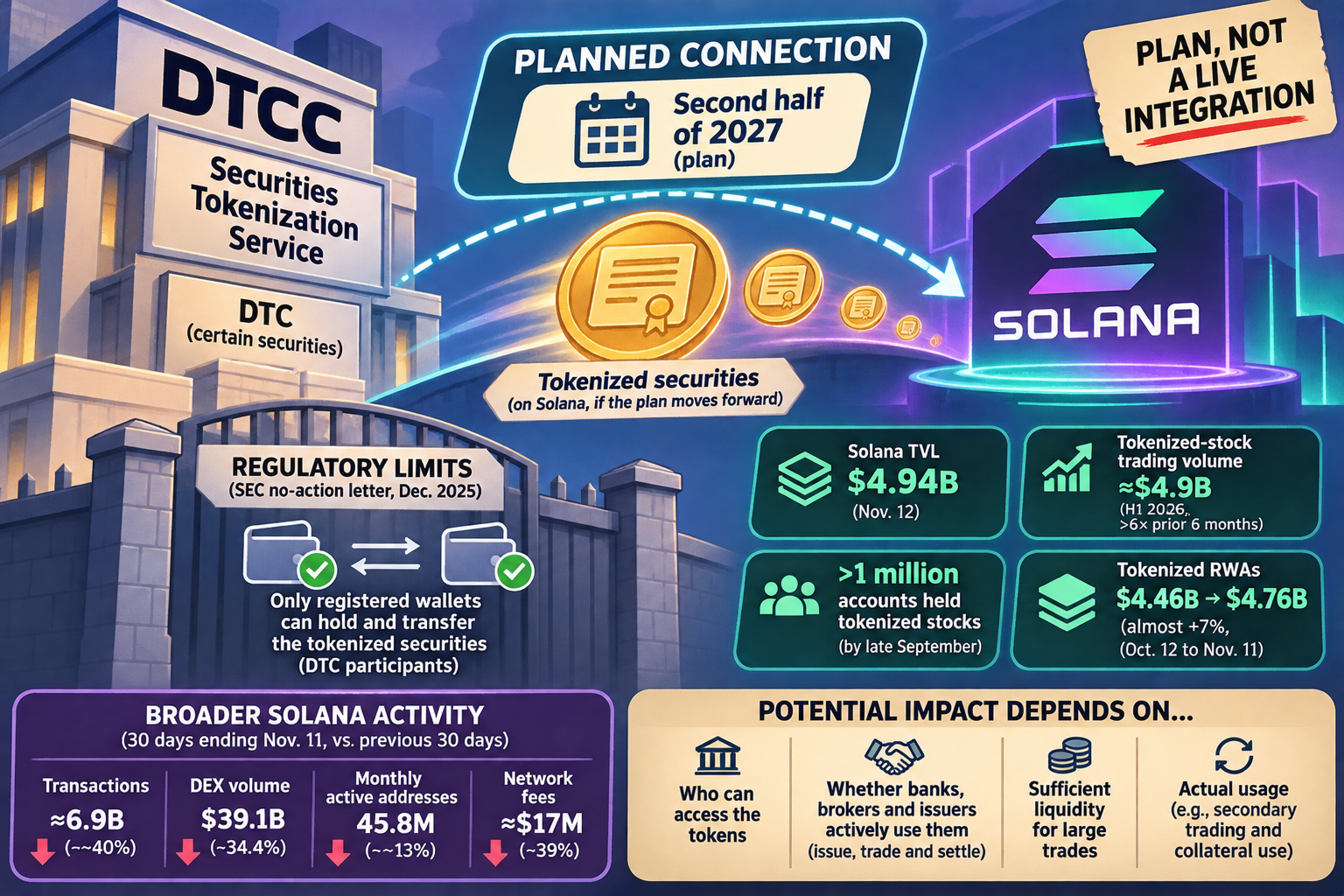
Alex Lin, founding partner at Reforge, argued that Solana’s experience handling heavy memecoin trading may have demonstrated its capacity for cheaper, high-volume activity. But he cautioned against assuming the DTCC plan would immediately bring permissionless trading to the network. Under a December 2025 US Securities and Exchange Commission no-action letter, DTC participants must register wallets to hold the tokenized securities, and transfers are limited to registered wallets. Lin described that as a near-term barrier to direct retail and DeFi access.
Tokenized assets rise as broader activity slows
Solana had about $4.94 billion in total value locked on Nov. 12, according to DefiLlama. Birdeye reported roughly $4.9 billion in tokenized-stock trading volume on Solana in the first half of 2026, more than six times the preceding six months. Its third-quarter report found that more than 1 million accounts held tokenized stocks by late September.
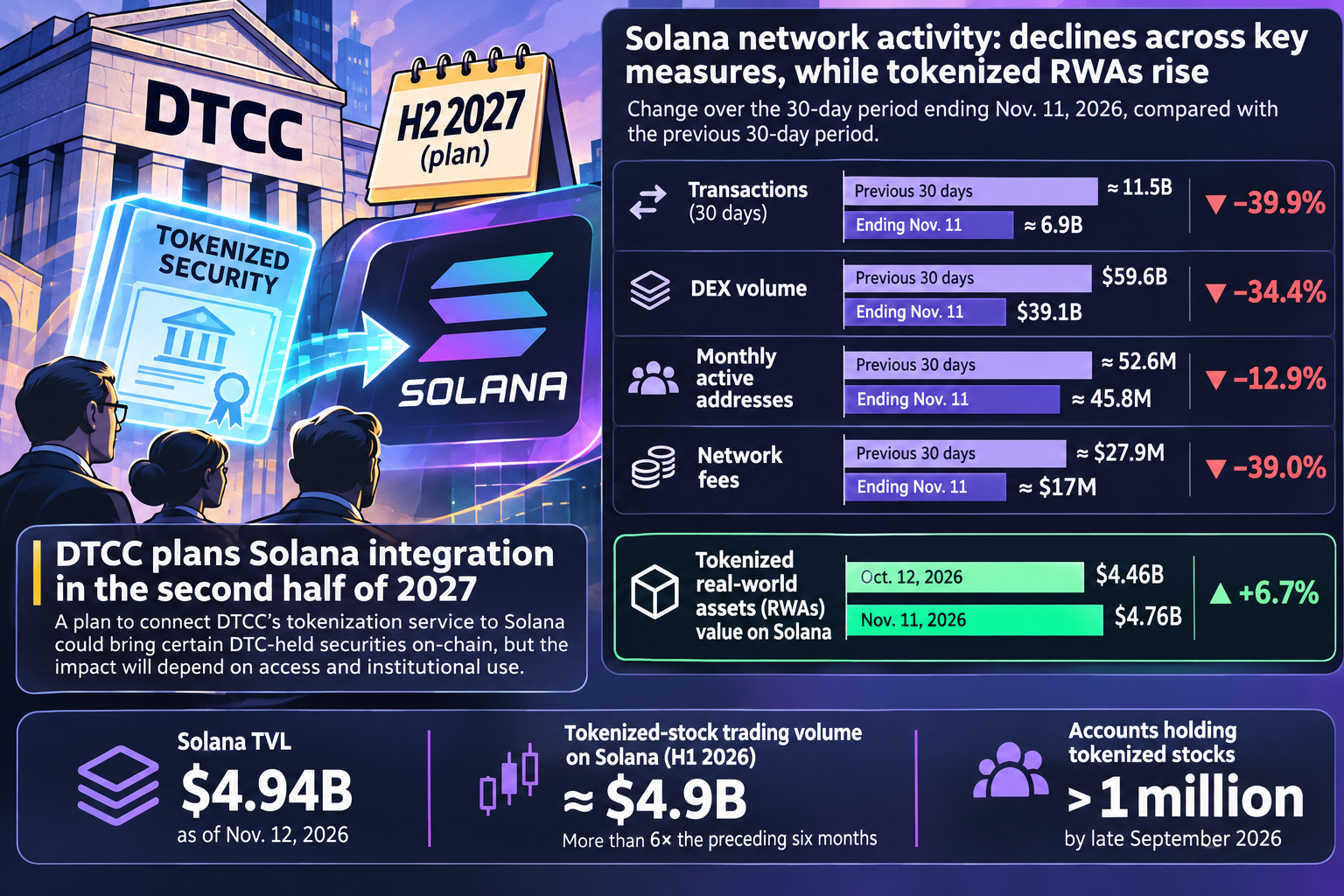
Other network measures moved the opposite way. Token Terminal data showed about 6.9 billion transactions in the 30 days ending Nov. 11, down almost 40% from the previous 30 days. Over the same comparison period, decentralized-exchange volume fell 34.4% to $39.1 billion, monthly active addresses declined nearly 13% to 45.8 million, and network fees fell 39% to about $17 million. Meanwhile, the value of tokenized real-world assets on Solana rose from $4.46 billion on Oct. 12 to $4.76 billion on Nov. 11, an increase of almost 7%.
Kha Nguyen, CEO and co-founder of Birdeye, cautioned that more securities on Solana would not automatically mean more transactions or demand for SOL. In his view, the deciding factors are whether banks, brokers and issuers actually issue, trade and settle there, whether large trades have sufficient liquidity, and whether the assets are used rather than simply held. Lin likewise pointed to secondary trading and collateral use—not the choice of issuance network—as the longer-term test.