
Strive reported $509 million in third-quarter net income on Friday, November 6, 2026. The bitcoin treasury company’s profit was entirely driven by unrealized gains on its BTC holdings, which exceeded $533.7 million for the quarter. Diluted earnings were $5.24 per share.
Strive bought 8,136 BTC during the quarter, ending it with 28,000 BTC. It acquired another 15,124 BTC in October, bringing its holdings to 43,124 BTC, valued at roughly $3.25 billion at the time of the report. Strive ranked fourth among publicly listed bitcoin treasuries, behind Strategy, Metaplanet and Twenty One. According to the report, it was 876 BTC short of second place at that point.

Revenue was roughly $2.7 million, mostly from investment advisory fees and the medical device business Strive acquired through its January takeover of Semler Scientific. At the end of October, Strive held $490.4 million in cash and equivalents; it also reported roughly $50.1 million in Strategy’s STRC preferred shares.
Bitcoin per share—and the share-price gap
Strive reported an 18.5% quarterly “bitcoin yield,” its measure of growth in bitcoin holdings relative to outstanding shares. After the earnings release, CEO Matt Cole wrote on X that “Bitcoin is the hurdle rate at Strive.” He argued that growth in bitcoin per share was the biggest driver of ASST’s more than 100% outperformance against bitcoin that year. Cole also pointed to Strive’s SATA and SATS preferred shares as a way to seek returns above bitcoin for shareholders.
Strive raised around $609 million through an October SATS offering and later launched a $1 billion program to sell additional SATS shares. In an early-September podcast appearance, Cole said ending the year as the second-largest corporate bitcoin holder was not “out of the realm of possibility.” That was his outlook, not a reported outcome.
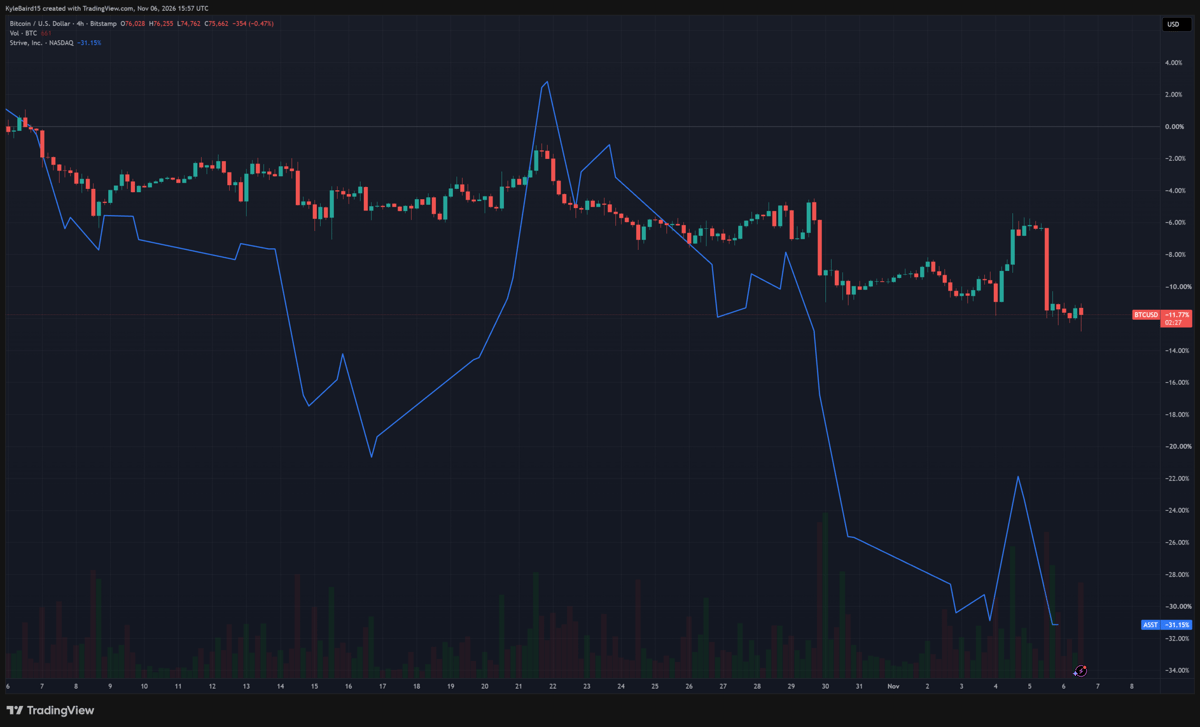
The near-term market picture was less favorable for ASST. In the first few hours of trading on November 6, the shares fell about 2% to $20.20, extending their 30-day decline to more than 31%. Bitcoin had fallen roughly 12% over the same period and was trading near $75,600. The comparison shows that ASST shares and bitcoin had moved differently over that window; the reported figures do not establish what caused the gap.