
As reported on November 16, 2026, bitcoin had fallen to a four-month low near $62,000 over the weekend before recovering to around $65,000 on Sunday afternoon. It was down about 13% over the preceding week. Bitwise Chief Investment Officer Matt Hougan said it could fall further if economic conditions worsened, even as he maintained a bullish long-term outlook.
The decline had largely erased bitcoin’s rise from the $58,000 range in June and July to around $86,000 in October. Many analysts had viewed the earlier range as the cycle’s ultimate low. Before the weekend’s price action, U.S. spot bitcoin exchange-traded funds had recorded more than $1 billion in net outflows for a second consecutive week.
Speaking with The Block’s Gareth Jenkinson at Solana Breakpoint in London, Hougan compared the risk of further losses with 2018. He recalled that investors thought bitcoin had found a bottom near $5,000 after falling from $20,000, only for it to drop to roughly $3,000. That was a warning about a possible further decline, not a prediction that the same pattern would repeat.
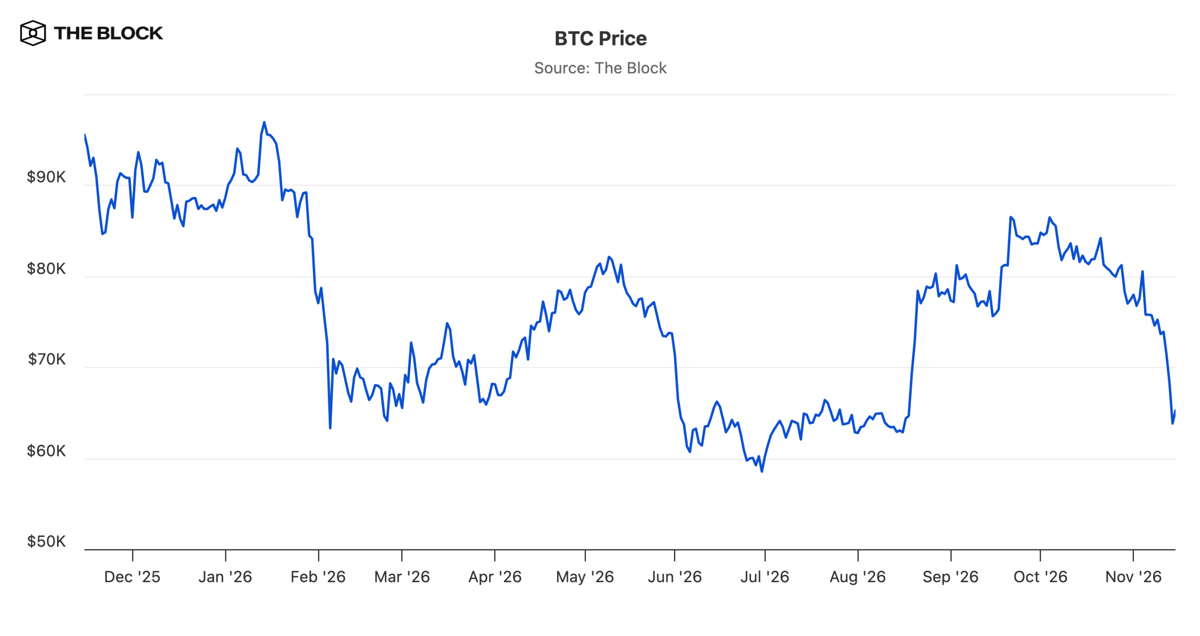
Hougan pointed to a recent Binance hack, the “blue wave” U.S. midterm elections, high U.S. inflation and the growing chance of another Federal Reserve rate hike when asked about the move. The market was “digesting this new regime where liquidity is tighter,” he said. He also noted that bitcoin remained above its June lows, calling that “resilience underneath the surface.” If it held up for the next handful of weeks, he said, crypto could be set up for a “very good 2027.”
Despite the near-term caution, Hougan called bitcoin “the best risk-adjusted trade in all of finance for the next 10 years.” He cited Morgan Stanley’s bitcoin ETF launch and Wells Fargo putting bitcoin into a model as examples of institutional adoption, and said institutional investors he speaks with had never sounded more optimistic about bitcoin and crypto. “The only thing lagging is price,” he said. Bitwise had previously raised its 10-year bitcoin price target to $1.6 million, a projection of a 34.3% annualized return—not an observed result.