
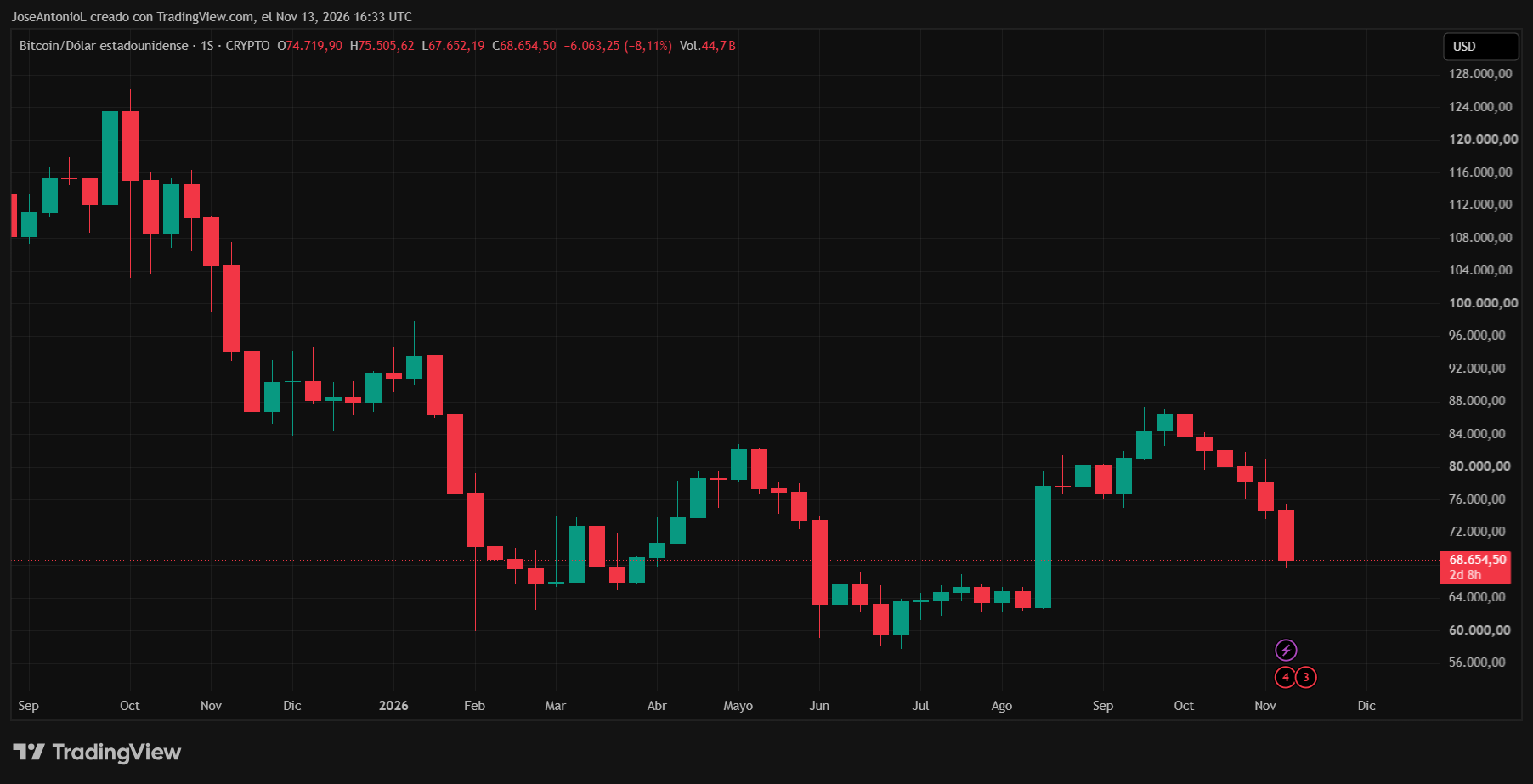
Bitcoin fell to roughly $68,500 on Friday, November 13, 2026, its lowest price in 12 weeks. It was down about 4.5% over 24 hours and 9.5% for the week, according to market data cited in the original report, published November 14, 2026, at 01:22 UTC+8. Ethereum traded near $1,925, while Solana slipped below $80.
The decline had erased most—but not all—of Bitcoin’s late-summer recovery. BTC remained about 16% above its late-June low near $59,000, despite falling roughly 21% from its autumn peak around $86,000.
Inflation and the December rate decision
Chicago Federal Reserve President Austan Goolsbee warned on November 13 that inflation pressures had spread beyond energy and tariffs. He pointed to rising services and medical costs and demand from AI data centers. “Are we on a path back to 2%? My feeling right now is we are not and we’ve got to deal with that,” he said, according to Reuters. Goolsbee did not explicitly endorse a December rate hike.
Fed Governor Christopher Waller had said on Tuesday that he supported raising rates by at least 25 basis points at the December 8–9 meeting. In his official remarks, he said core consumer inflation of around 0.3% or higher in October could warrant considering a stronger move. The subsequent reading was 0.3%, above the 0.2% forecast. That met his stated threshold for considering a larger increase; it was not a Fed decision.
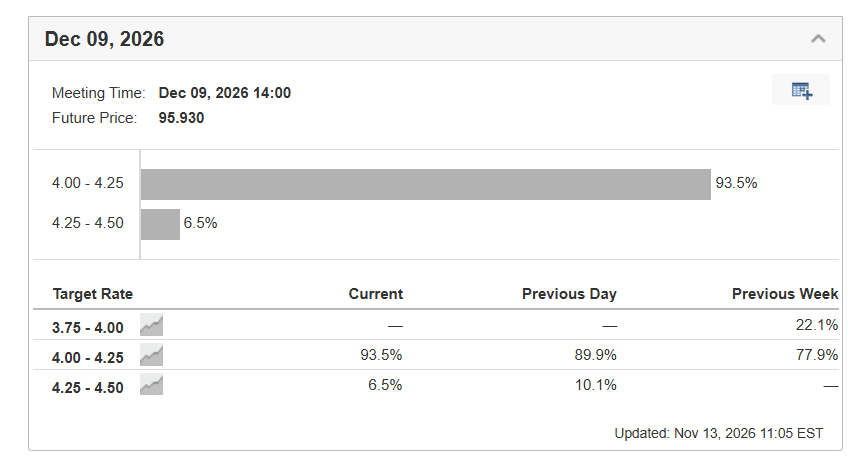
As of November 13, futures-based probabilities put a quarter-point increase at 91.9% and a half-point increase at 8.1%. Those were trader expectations, not enacted policy. The Fed’s target range stood at 3.75%–4.00%. Friday’s producer-price report added a mixed signal: wholesale prices rose 0.3% in October, less than forecast, but were up 6.5% year over year—the largest annual increase since 2022.
Higher interest rates can make interest-bearing investments relatively more attractive than speculative assets. That offers context for Bitcoin’s weakness, but does not establish how much of the decline rate expectations caused.
ETF outflows and the price chart
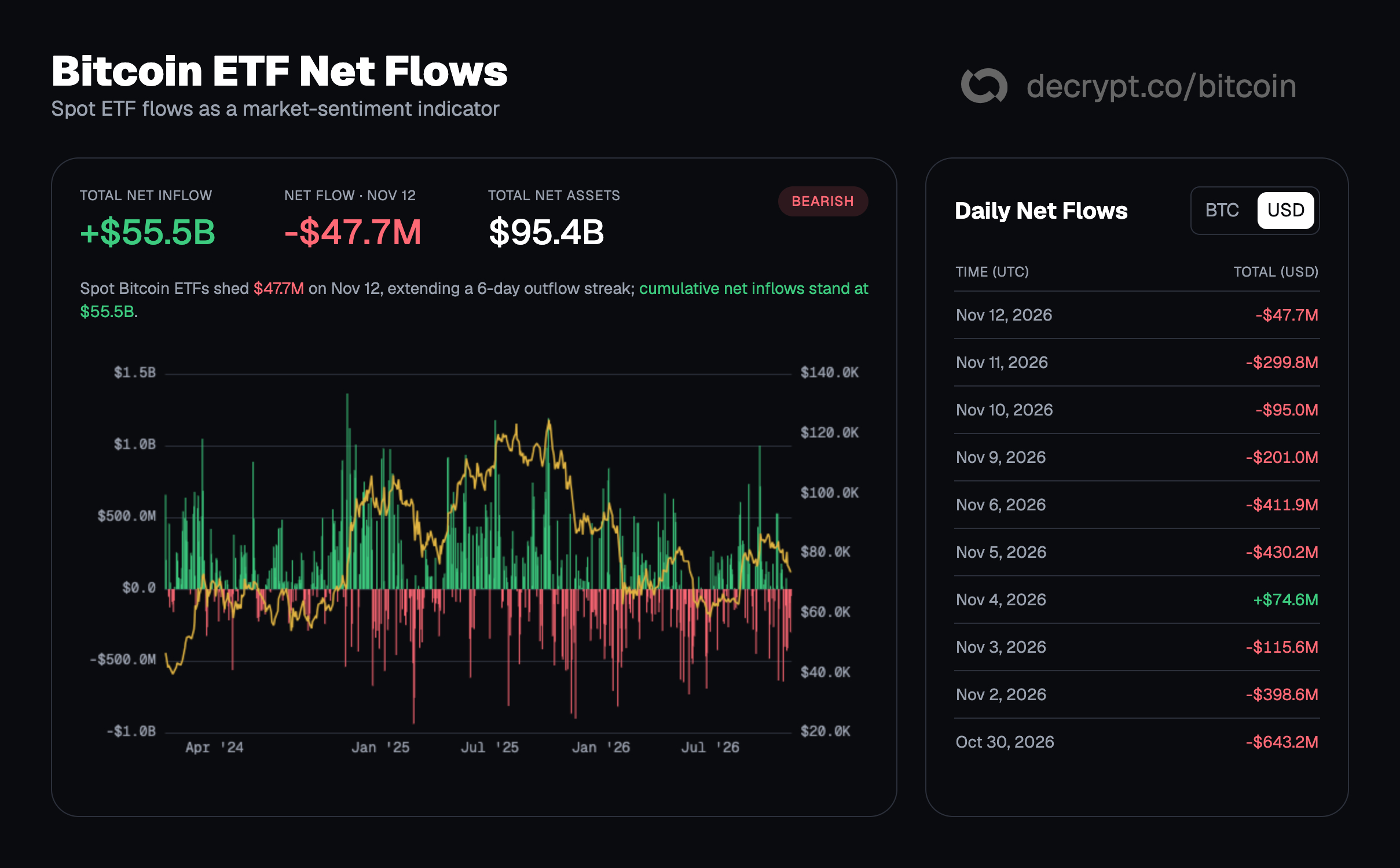
U.S. spot Bitcoin ETFs recorded approximately $1.49 billion in net outflows across six consecutive sessions from November 5 through November 12, including $47.7 million on Thursday. The funds nevertheless retained approximately $55.5 billion in cumulative net inflows. Outflows can add pressure when demand is thin; forced liquidations of leveraged positions can amplify a decline, though the report did not quantify such liquidations.
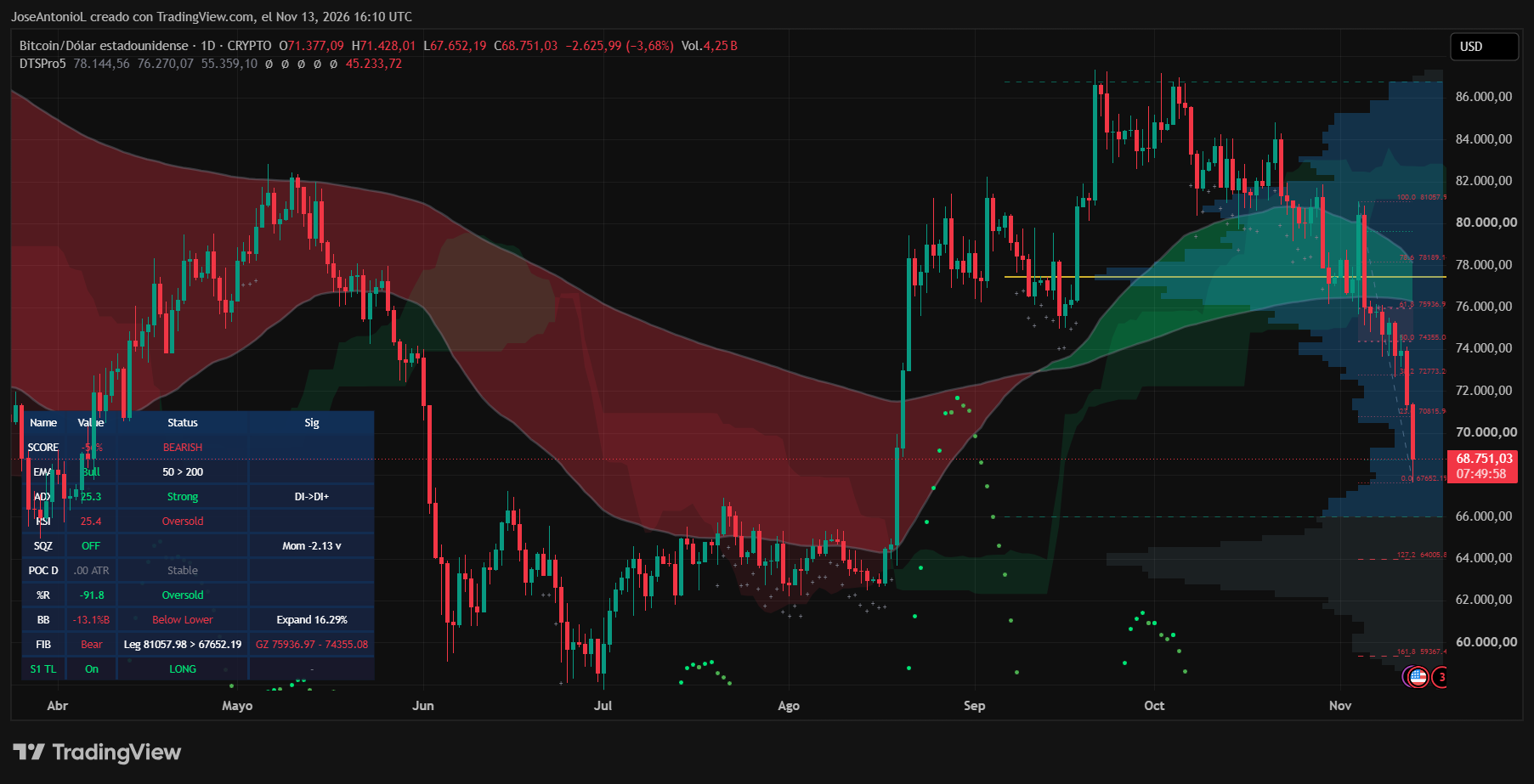
At the November 13 snapshot, Bitcoin’s daily chart showed lower highs and lower lows. Its relative strength index was 25.4, below the level of 30 commonly treated as oversold, while its average directional index was 25.3, indicating an established trend. The 50-day exponential moving average remained above the 200-day average, but Bitcoin traded below the shorter-term average. An oversold reading alone did not establish a bottom.
The report identified Friday’s intraday low near $67,650 as immediate support, with another area near $64,000 if that level failed. It marked $70,815 and $72,775 as levels to recover before a resistance zone between $74,355 and $75,937. These were chart levels from that historical snapshot, not current prices or forecasts. At the time, traders were also awaiting the Fed’s November 18 meeting minutes and the November 25 PCE inflation report ahead of December’s rate decision.